Equality Action Plans: What UK Employers Must Publish by 2027
25 June 2026 by Mark Holt
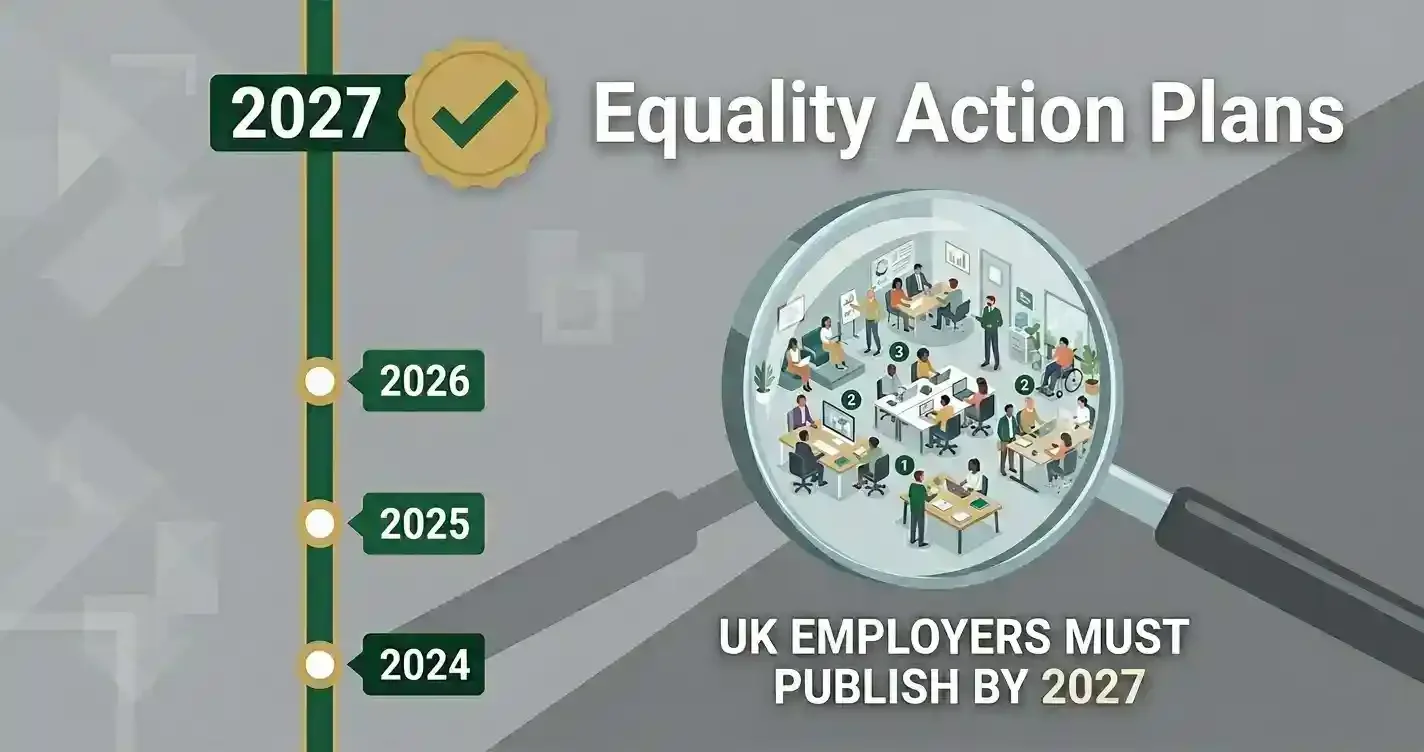
From 1 January 2027, employers in Great Britain with 250 or more staff will have to publish an equality action plan: a document setting out the concrete steps they are taking on gender equality, including closing their gender pay gap and supporting employees through the menopause. Employers can start publishing voluntarily from April 2026. Unlike the gender pay gap report — which only requires you to state the numbers — an action plan requires you to explain, with evidence, why the gap exists and what you have actually done about it.
That shift from reporting to explaining is the whole story. A number can come straight from payroll. An evidence-based explanation of why women are paid less, or whether menopause is quietly pushing experienced women out, can only come from asking your people — anonymously, and in a way you can segment. This guide explains the new duty and the data you will need to meet it credibly.
Divrsity Disclaimer
This article describes the equality action plan duty as introduced by the Employment Rights Act
2025, based on the position as at June 2026. The detailed requirements will be set out in
regulations that are still being finalised, so specifics may change before the duty takes effect.
This is general guidance, not legal advice — check the final regulations and take professional
advice for your own circumstances.
What is an equality action plan?
An equality action plan is a published statement of the steps an employer is taking on prescribed gender-equality matters. It was introduced by the Employment Rights Act 2025 and sits alongside, rather than replaces, the existing gender pay gap report. The two are complementary: the pay gap report tells the world what your gap is; the action plan commits you to explaining why and saying what you are doing to close it.
Two matters are central to the plan. The first is the gender pay gap: where a gap exists, you must provide an evidence-based analysis of the factors behind it — which may mean auditing recruitment practices, policies and progression opportunities — and demonstrate the steps you have taken in the previous twelve months to close it. The second is menopause support: the plan must set out how you are supporting employees through the menopause, recognising it as a workplace issue that disproportionately affects the retention and progression of experienced women.
When does it become mandatory, and who does it apply to?
The timeline is staged. Employers will be able to publish an equality action plan voluntarily from April 2026, and it becomes mandatory from 1 January 2027 for employers with 250 or more employees — the same threshold long used for gender pay gap reporting. The detailed mechanics will be set out in regulations under the Employment Rights Act 2025.
The voluntary window is not a throwaway concession. It is a chance to build and test your plan — and gather the underlying evidence — a full year before it is scrutinised. Employers that treat April 2026 as the real start line will be in a far stronger position than those waiting for January 2027, because a credible action plan rests on data you cannot collect retrospectively.
Why "evidence-based analysis" changes everything
The phrase that should focus every HR director's attention is evidence-based analysis of why a gap exists. The gender pay gap report has been criticised for years precisely because it stops at the number: organisations publish a percentage, attach a few paragraphs of boilerplate, and change nothing. The action plan is designed to close that loophole by demanding that you show your working.
A pay gap is almost never caused by paying men and women differently for the same job — that has been unlawful since the Equal Pay Act 1970. It is caused by structure: who gets recruited into which roles, who gets promoted, who has access to the high-visibility work, who leaves and why. To evidence that, you have to look beyond payroll and into experience — and you have to be able to segment that experience by gender, age and other characteristics. A headline staff-survey average will not do it, because the whole point is to find where one group's experience diverges from another's.
The data you need — and where it comes from
A credible equality action plan draws on three kinds of evidence, only one of which lives in your HR system:
1. The pay and progression numbers — your existing gender pay gap data, plus promotion, recruitment and attrition rates split by gender. These you already hold. 2. The lived experience — how fair people believe recruitment and promotion to be, whether they feel they have equal access to development, and how belonging and psychological safety vary by group. This you can only get by asking. 3. The menopause picture — whether employees going through the menopause feel supported, whether they have considered reducing hours or leaving, and what would actually help. This is sensitive, and people will only answer honestly under genuine anonymity.
The second and third are where most plans will stand or fall, and they are exactly what an anonymous DEI survey is built to capture. By pairing demographic questions with workplace-experience questions — what we call Lenses — you can see precisely where women's experience diverges from men's, and where menopause is quietly affecting retention. Our dedicated article on the menopause at work goes into why this matters and how to ask about it sensitively.
Menopause: the part employers most often get wrong
Including menopause support in the equality action plan is a deliberate signal from Government that it is no longer a fringe wellbeing topic but a mainstream retention issue. Women over 50 are the fastest-growing segment of the workforce, and menopause symptoms — at exactly the career stage when many women are reaching senior roles — are a documented driver of reduced hours and early exits. A gender pay gap that widens at senior levels is often a menopause story hiding in plain sight.
The difficulty is that almost nobody will raise it through line management. The only reliable way to understand the scale of the issue in your organisation is to ask anonymously, and to let people tell you what support would genuinely make a difference. That insight then feeds directly into the "menopause support" section of your plan as evidence, rather than a list of well-meaning intentions.
From evidence to a plan that stands up
Once you have the evidence, the plan needs to convert it into a small number of specific, deliverable commitments — and then show progress against them year on year. This is where an anonymous survey earns its keep twice over: first as the diagnostic that tells you where to act, and then as the measure that tells you whether your actions worked.
On the Divrsity platform that loop is largely automatic. An interactive results dashboard is generated within about 10 minutes of a survey closing — filterable by gender, age, team and location, with intersectional breakdowns and open-text themes already extracted — followed by a prioritised, AI-generated action plan within 24 hours. Run the same survey on a regular cadence and you can benchmark your own progress, which is exactly the "steps taken in the last twelve months" evidence the action plan requires. Because the analysis runs on UK-based servers and UK-built AI, sensitive data never leaves the country.
If you are also preparing for the related changes on ethnicity and disability pay gap reporting, the good news is that one well-designed survey can gather the evidence for all of them at once — the demographic and experience data is the same; only the lens you view it through changes.
Frequently Asked Questions
What is an equality action plan?
An equality action plan is a published document in which an employer sets out the steps it is taking on specified gender-equality matters — principally closing its gender pay gap and supporting employees through the menopause. Under the Employment Rights Act 2025, large employers in Great Britain will be required to produce and publish one. It must go beyond stating the gap to explain, with evidence, why the gap exists and what the employer has done in the last twelve months to close it.
When do equality action plans become mandatory in the UK?
Employers will be able to publish equality action plans voluntarily from April 2026, and they become mandatory from 1 January 2027 for employers with 250 or more employees. The exact requirements will be set out in regulations under the Employment Rights Act 2025, so the detail may still change before the duty takes effect.
Who has to publish an equality action plan?
The duty applies to employers in Great Britain with 250 or more employees — the same threshold used for gender pay gap reporting. Smaller employers are not required to publish one, though many choose to adopt the same approach voluntarily because it demonstrates a credible commitment to equality.
What must an equality action plan include?
An equality action plan must address prescribed gender-equality matters, including the steps the employer is taking on its gender pay gap and how it supports employees through the menopause. Where a pay gap exists, the employer must provide evidence-based analysis of why, examining factors such as recruitment, progression and policies, and demonstrate the steps it has taken in the previous twelve months to close it. Employers may also need to reference the gender pay data of the outsourcing providers they use.
What data do I need to build an equality action plan?
Because the plan demands evidence-based analysis of why a gap exists, you need more than payroll numbers. You need workforce experience data segmented by demographic — perceptions of fairness in recruitment and promotion, access to development, and the lived experience of employees going through the menopause. An anonymous DEI survey is the most reliable way to gather this, because it links demographic information to experience while protecting the individual.
Conclusion: start in 2026, not 2027
The equality action plan turns gender pay gap reporting from a number into an argument: you must now explain why your gap exists and prove you are acting on it. That argument can only be built on segmented, honest evidence about how your people actually experience recruitment, progression and the menopause — and that evidence takes time to gather and trust to obtain.
The smart move is to use the voluntary window. Run an anonymous survey in 2026, find out where the real drivers of your gap sit, act on a small number of them, and you will walk into January 2027 with a plan that is already working — rather than a deadline you are scrambling to meet.
Related Articles See All Blog Articles
- Understand the related pay-gap duties on ethnicity and disability
- Read our guide to supporting employees through the menopause at work
- Learn the full process in our eight-step guide to running a DEI survey, and how to maximise participation
- See why genuine anonymity produces honest answers, and how to measure psychological safety
- Use your results to benchmark your own progress over time, and see why every UK industry needs to listen and act in 2026
References:
- GOV.UK. Employment Rights Bill / Act collection. https://www.gov.uk/government/collections/employment-rights-bill
- GOV.UK (2026). New government guidance on equality action plans. https://www.gov.uk/government/publications
- Equality and Human Rights Commission. Gender pay gap reporting. https://www.equalityhumanrights.com/